


pleaseBU A57 | Upper-arm blood pressure monitor
- Large, easy-to-read display
- Blood pressure classification using a traffic-light color scale
- 199 memory slots per user (2 users)
£21.63
% Regular price: £25.92 (16% saved)
Temporarily unavailable
Parts of this content may be AI-generated. Editorially reviewed.
Kunden kauften auch:

Simple health monitoring from homeThe PM 100 pulse oximeter from medisana reliably and accurately measures blood oxygen saturation and heart rate. Both measurements can be displayed on the easy-to-read OLED display in four different viewing perspectives in bar or waveform format. After eight seconds the device switches off automatically, conserving the batteries. This is just one of the advantages of this medical device from Medisana. Simple “One Touch” operation – ideal for on the goThe PM 100 pulse oximeter is not only a practical everyday companion at home, but also when traveling. The handy “One Touch” operation is ideal for use on the go. With just one button press you start the measurement. Adjustable display brightness in ten levelsThe measurements on the PM 100 pulse oximeter are shown on a high-quality OLED display. Thanks to the ten available levels, you also have the option to adjust the display brightness individually to your needs or the ambient light. Product highlights Accurate measurement of blood oxygen saturation (SpO?) and heart rate Easy-to-read OLED display with high-contrast presentation Seven selectable display views for individual display Adjustable display brightness in 10 levels for optimal readability Display of the perfusion index (PI) to assess pulse strength Simple One-Touch operation – ideal for on the go Automatic shut-off after 8 seconds to conserve battery Includes lanyard and batteries – ready for immediate use Technical data Size: approx. 5.8 x 3.4 x 3.5 cm Weight: approx. 53 g Measurement range: SpO2: 70% ~ 100% Pulse: 30 - 235 beats/min. Batteries: 2 x 1.5 V (AAA)

Precise wrist blood pressure measurementThe medisana BW 355 wrist blood pressure monitor enables quick and reliable blood pressure checks. It measures systolic, diastolic and pulse precisely and also displays date and time. Thanks to automatic shut-off, an integrated error indicator and a practical storage case, the device is ideal for daily use at home and on the go. Clear display with traffic light color scaleThe integrated traffic light color scale makes it easy to classify measurement results at a glance. Systolic, diastolic and pulse are displayed clearly and can be immediately assessed using the color indicator. The BW 355 also detects irregular heartbeats and signals user errors. This ensures safe, simple and precise wrist blood pressure measurement at all times. Large display for comfortable readingThe BW 355 features an extra-large LC display with white backlight. All measurements such as blood pressure and pulse are therefore always easy to read, even in poor lighting conditions. The clear presentation provides high user comfort and supports reliable health monitoring. This makes wrist blood pressure measurement even easier and more comfortable. Memory function for 2 usersThe BW 355 wrist blood pressure monitor offers 199 memory slots for each of two users. This allows multiple people to document and compare their blood pressure readings over time. In addition, the device calculates the average of the last three measurements, enabling a meaningful assessment of blood pressure trends. Product highlights at a glance Classification of readings with traffic light color scale Display of systolic, diastolic, pulse, date and time Detection of irregular heartbeats Calculation of the average of the last three measurements Suitable wrist cuff for 13.5–19.5 cm circumference Error notification for safe use Automatic shut-off to save battery Supplied with batteries and storage case Technical specifications Size: approx. 9 x 2.85 x 6.6 cm Weight: approx. 0.128 kg Measurement method: Oscillometric Measurement range: Blood pressure: 0 – 295 mmHg Pulse: 40 – 199 beats/min. Batteries: 2 x 1.5 V (AAA)

Optical and acoustic fever alarmThe infrared body thermometer TM A79 features both an optical and an acoustic fever alarm that categorizes the measured temperature into three levels by a color change. Green indicates normal temperature, yellow a mildly elevated temperature and red an elevated temperature. Particularly practical: the last 50 readings are automatically saved and can be retrieved at any time. Precise, seconds-fast and contactless measurementThe infrared body thermometer TM A79 measures body temperature completely contactless while still delivering precise and reliable results. Thanks to its additional function, the certified medical device can also measure ambient temperature as well as the temperature of liquids and surfaces from 0 to 100 °C. Extra-large and easy-to-read LCD displayThe medisana infrared body thermometer TM A79 impresses with its extra-large and easy-to-read LCD display. The backlight ensures that readings are clearly visible even in low light conditions. The temperature can be switched from Celsius to Fahrenheit if desired. In addition, the body thermometer is equipped with an energy-saving auto-off function after 18 seconds. Product highlights Precise and seconds-fast measurement of body temperature on the forehead Contactless operation for hygienic measuring Optical and acoustic fever alarm with three-color indication (Green, Yellow, Red) Extra-large, illuminated LCD display for optimal readability Automatic storage of the last 50 measurement results Two integrated modes: Body mode (34–43 °C) and Surface mode (0–100 °C) Switchable between °C and °F Auto-shutoff after 18 seconds for energy saving Measuring distance of 1–5 cm for comfortable use Includes batteries Technical data Size: approx. 138 x 95 x 40 mm; Weight: approx. 90 g (without battery) Measurement range: Body: 34 - 43.0 °C Measurement range: Surfaces: 0 - 100 °C Scale: 0.1 °C Measuring distance: 1 - 5 cm
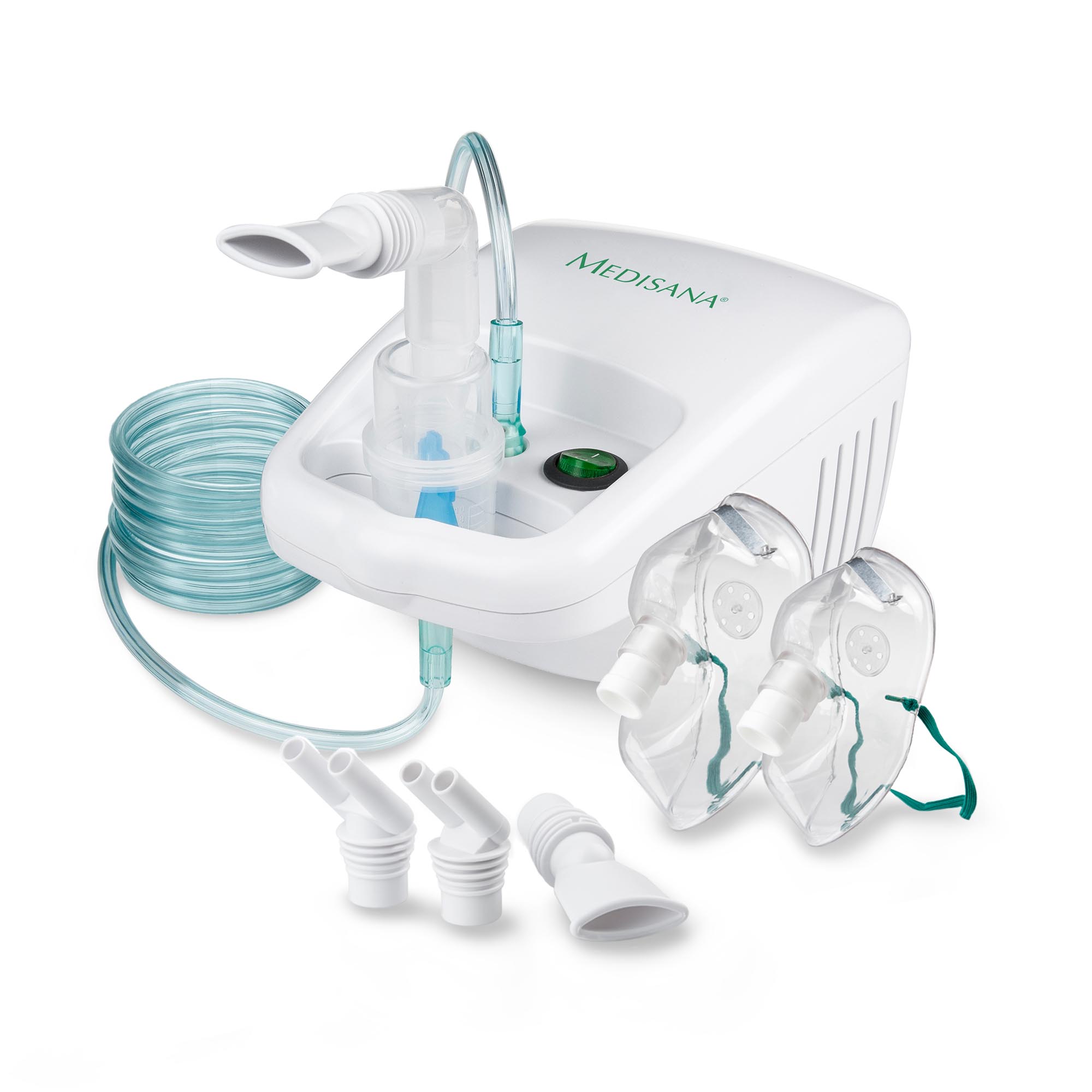
Targeted inhalation therapyWith the IN 500 inhaler from medisana, you can specifically treat conditions of the upper and lower respiratory tract such as colds or asthma. Aerosol inhalation therapy can help relieve respiratory complaints. In aerosol therapy, medications are turned into an „airborne“ form – by the nebulization used here – and then inhaled. The great advantage of this therapy is that the medications are administered directly where they are intended to act. Nebulization with compressor compressed-air technologyThe IN 500 Compact inhaler nebulizes the active ingredients using modern compressor compressed-air technology. The finest nebulization achieves particularly high effectiveness. Comprehensive accessories: inhalation with mask, mouthpiece or nasal adapterThe scope of delivery includes a nebulizer set with a two-meter air hose, a mouthpiece, a nasal adapter each for adults and children, an adult mask and a child mask, as well as five replacement air filters. The device is also ideal for use with children. Product highlights Targeted inhalation therapy for the upper and lower respiratory tract High efficacy through ultra-fine, lung-penetrating nebulization Versatile use with mask, mouthpiece or nasal adapter Ideal for the whole family – also suitable for children Powerful compressor technology for consistent nebulization Particularly effective for colds, asthma and respiratory complaints Extra-long 2-meter hose for comfortable use Certified medical device for safe home use Technical data Size: approx. 19.5 × 13.5 × 9.2 cm; Weight: approx. 1.3 kg Power supply: 230V~ 50 Hz; Power: 60 watts Filling capacity: max. 10 ml Nebulization: ? 0.2 ml/min; Particle size: >60% ? 5 ?m Hose length: approx. 2 m
Product information "pleaseBU A57 | Upper-arm blood pressure monitor"
Reliable upper-arm blood pressure measurement
The BU A57 upper-arm blood pressure monitor enables precise and comfortable blood pressure measurement for everyday use. The large cuff (22–42 cm) ensures a comfortable fit, while the arrhythmia indicator provides additional safety. As a certified medical device (MDR), the unit stands for tested quality and reliable measurement results in daily life.
Easy readability thanks to extra-large digits
The extra-large display with digits up to 22 mm high ensures quick and clear readability. All measurements – from systolic and diastolic to pulse – are clearly presented at a glance, so measurements can be taken without effort or prolonged checking.
Comprehensive display of all relevant measurement data
In addition to blood pressure and pulse readings, the BU A57 also displays date and time. Blood pressure classification via the traffic-light color scale makes it easy to assess results at a glance. Irregular heartbeats are detected automatically, and 199 memory slots for each of two users allow simple documentation and evaluation of the measurement history.
Practical accessories for immediate use
The device is supplied with batteries and a storage pouch – ideal for immediate use and secure storage. Thanks to its compact design, the BU A57 can be stored conveniently and taken anywhere, whether for use at home or on the go.
Product highlights at a glance:
- Precise upper-arm blood pressure measurement
- Large cuff for 22–42 cm arm circumference
- Extra-large, easy-to-read digits (up to 22 mm)
- Arrhythmia indicator for irregular heartbeats
- Traffic-light color scale for immediate blood pressure classification
- 199 memory slots for each of two users
- Selectable mains or battery operation
- Includes batteries, ready to use
- Certified medical device (MDR)
Technical data:
- Size: approx. 13 × 11 × 6 cm
- Weight: approx. 258 g
- Measurement method: Oscillometric
- Measurement range:
- Blood pressure: 0 – 295 mmHg
- Pulse: 40 – 199 beats/min.
- Batteries: 4 × 1.5 V (AA)
Login